

Start your day with homemade Manakish Za’atar, irresistible Middle Eastern flatbreads topped with za’atar and olive oil.
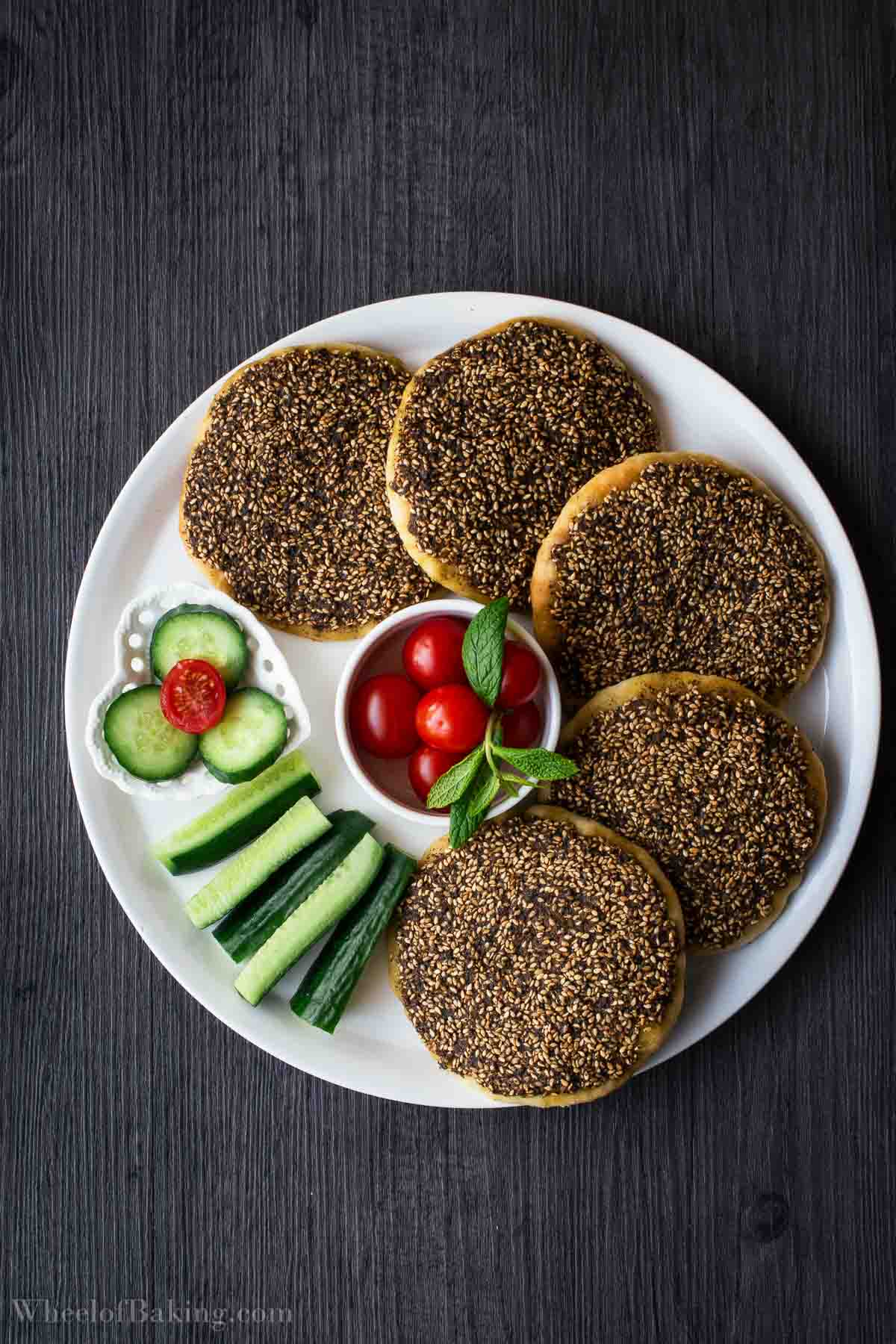
Growing up in Lebanon, manakish were often the breakfast of choice for the weekend. We always looked forward to going to the bakery where the smell of za’atar would immediately lure us in. I had honestly never considered trying a homemade version. But when I was gifted several packs of za’atar, I decided to give it a try and I’m so glad I did.
Why You’ll Love This Recipe
- The perfect breakfast: I might be biased coming from a Middle Eastern household but I think the smell of baked manakish is one of the most comforting smells.
- Easy: You’ll find this recipe very easy to make even if you’re not comfortable baking with yeast. No need for a mixer and we’re baking the manakish right after shaping them.
- Customizable: You can easily adjust the size of the manakish, the amount of topping and even the type of topping. You can also enjoy the flatbread plain!

Ingredients
- Flour: For structure. I’m using all-purpose flour (mine is about 11% protein).
- Water: For hydration. We’re using quite a bit of water in this recipe, 77% the amount of flour. To make the dough easier to handle, we’ll be pouring boiling water over part of the flour to pre-gelatinize the starches so they can hold onto more water.
The boiling water method allows us to add more water to the dough for a softer result without making the dough overly sticky. This technique also partially denatures the proteins in flour that are responsible for gluten formation, yielding dough that is easier to roll out without it bouncing back, as less gluten is formed.
- Instant yeast: For a little bit of rise, fluffiness and flavor. I like to dissolve the yeast in a little bit of warm water before adding it to the dough. Just to give you an idea of the role of yeast, I made a batch omitting it (pictured left, below). Ignore the messy shape! I simply patted them with my hands quickly but I thought I’d share my experiments with you. The flatbreads made without yeast were dense, doughy, not flexible at all and didn’t brown much.

- Olive oil: We’ll be using a little bit of olive oil when mixing the dough and some for the filling. The oil makes the dough easier to work with (less sticky) and less likely to bounce back when rolling it out. It will also prevent the manakish from drying out too quickly. Too much oil however will lead to a heavy flatbread so we’ll be using just enough to get all the benefits! For the filling, you need just enough oil to make the filling easily spreadable but not so much that it leaks everywhere.
- Sugar: For browning, sweetness and a source of food for the yeast.
- Salt: For flavor. Too little salt can lead to a bland flatbread. I found a scant teaspoon to be the perfect amount for flatbread that tastes amazing even without topping.
- Za’atar: I’m using Lebanese store-bought za’atar generally composed of wild thyme, sumac, toasted sesame seeds and salt. Depending on the country, za’atar could include additional ingredients (such as cumin or coriander). You should be able to find some in Middle Eastern stores or online. Alternatively, you could try making it at home or skip it and enjoy the baked flatbread with yogurt for example (or tzatziki, a favorite in my house!)
Step-by-Step Instructions
- Mix together in a bowl part of the flour with boiling water. Set aside for 20-30 minutes.


- Dissolve the yeast in a little bit of warm water.


- Add the remaining flour to the flour mixture, followed by the oil, sugar, salt and yeast mixture.


- Knead until combined and set aside briefly until puffy.


- Divide the dough into evenly sized pieces.


- Pat each piece into a circle then roll it out to desired size and thickness.


- Top with the za’atar mixed with oil, leaving a small border around the edge to prevent leaks.
- Bake until puffed up and golden.


Enjoy!
More Middle Eastern Recipes
LOVE THIS RECIPE? I’d be so grateful if you could leave a ⭐⭐⭐⭐⭐ rating in the recipe card below!

Manakish Za’atar
Start your day with homemade Manakish Za’atar, irresistible Middle Eastern flatbreads topped with za’atar.

6
manakish15
minutes22
minutes1
hourIngredients
260 g all-purpose flour, divided (9.2 oz., 2 cups)
180 g boiling water (6.3 oz., 3/4 cup)
6 g instant yeast (0.21 oz., 2 teaspoons)
20 g warm water (around 43°C/110°F) (0.7 oz., 4 teaspoons)
20 g olive oil (0.7 oz., 1 and 1/2 Tablespoons)
10 g white granulated sugar (0.35 oz., 3/4 Tablespoon)
5 g salt (0.18 oz., a scant teaspoon)
- For the topping
40 g za’atar (1.4 oz., 5 Tablespoons)
30 g olive oil (1.1 oz., 2 Tablespoons)
Directions
- Place 170 g (1 and 1/3 cups) of flour in a large bowl. Pour the boiling water over it and mix with a wooden spoon until combined, scraping the bottom and sides of the bowl. Cover with a heatproof plate and set aside for 20-30 minutes.
- Meanwhile, about 5 minutes before the end of the rest time, briefly stir together the instant yeast and warm water in a small bowl using a fork and set aside.
- Pour the remaining flour (90 g, 2/3 cup), olive oil, sugar, salt and yeast mixture (briefly stirred again) over the cooled flour mixture. Mix with a wooden spoon or knead with lightly oiled hands just until all the ingredients are fully combined, about 2-3 minutes. Tip: Make sure the flour mixture isn’t hot before adding the yeast.
- Cover once more and set aside for 30 minutes.
- In the meantime, prepare the topping by combining the za’atar and olive oil in a small bowl. Preheat the oven to 220°C (428°F, conventional setting) and line two baking sheets with parchment paper. Note: Check the maximum safe temperature of your parchment paper written on the packaging before using.
- Gently punch down the dough and divide into 6 equal pieces, about 80 g (2.8 oz.) each. Take a piece of dough with lightly oiled hands and shape into a rough ball to smooth the surface. Then pat into a circle on a small piece of parchment paper (or lightly floured surface). Top with another piece of parchment paper and roll out into a 15 cm (6 inch) circle with a rolling pin, about 2 mm (0.08 inch) thick, or desired size and thickness. Transfer to prepared baking sheet, adjusting the shape with your hands if needed. Repeat with the remaining dough then top with za’atar mixture, leaving a small border (without topping) around the edge.
- Bake in the middle of the oven (one sheet at a time) until lightly puffed up with golden edges, about 10-11 minutes. Remove from the oven and cool down briefly on the baking sheet. Serve warm with sliced tomatoes, cucumbers and mint leaves and fold in half if desired. Enjoy!
Notes
- Yield: This recipe is enough to make about 6 manakish. Feel free to adjust the size and thickness to your liking (thicker manakish will be breadier and softer). Just note that the baking time might vary. If making them thicker and smaller (up to 13 cm/5 inches) than called for in the recipe, you might be able to bake them all together on one large baking sheet.
- Make-ahead tips: Manakish are best served warm. If you wish to save them for later, cool down on a wire rack then place in an airtight container. Alternatively, wrap the manakish individually well (once cooled down) and freeze. Thaw at room temperature. Briefly warm up in the oven if desired.
- Shaping the dough: This dough is quite sticky but should be easy to handle with oiled hands. Use additional flour only if necessary. You can roll out the dough between two pieces of parchment paper to avoid adding more flour. But if you’d rather not use parchment paper, lightly flour the rolling pin and dough if it is too sticky before rolling it out.
- Topping the dough: I find it best to drop small amounts of za’atar mixture all over the dough before spreading it evenly with the back of a spoon. You might find it hard to spread if you start with one big spoonful in the middle. Adding more oil to the mixture does make the topping more spreadable but it might leak from the sides and the manakish will feel heavier. Feel free to use as much topping as you’d like. For a very generous amount of topping (as in the featured image), you can use 60 g (7 and 1/2 Tablespoons) of za’atar and 50 g (3 and 1/2 Tablespoons) of olive oil.
- Variations: For lighter manakish, you could brush the rolled out dough with oil and then sprinkle the za’atar mix over the dough. If you’d prefer an even lighter result, you can omit the oil from the topping and simply sprinkle the dough with za’atar. Those who wish can then drizzle a little bit of olive oil over their portion before eating. You could even omit the topping if you’d like to enjoy the baked flatbread with yogurt, dipped in olive oil etc.
- Salt: You might need to adjust the amount of salt depending on the za’atar you have and your preference. If the za’atar doesn’t contain any salt, you could add a little when mixing it with the oil. If the za’atar you have is very salty, you might want to spread a thinner layer of topping onto the dough.
- Baking the manakish: The oven temperature and baking time will affect the softness of the dough. For soft, flexible manakish, it’s best to bake at a high temperature for a short period of time.
- Cup measurements: Please note that these measurements are approximate. For best results, I’d recommend weighing the ingredients.