
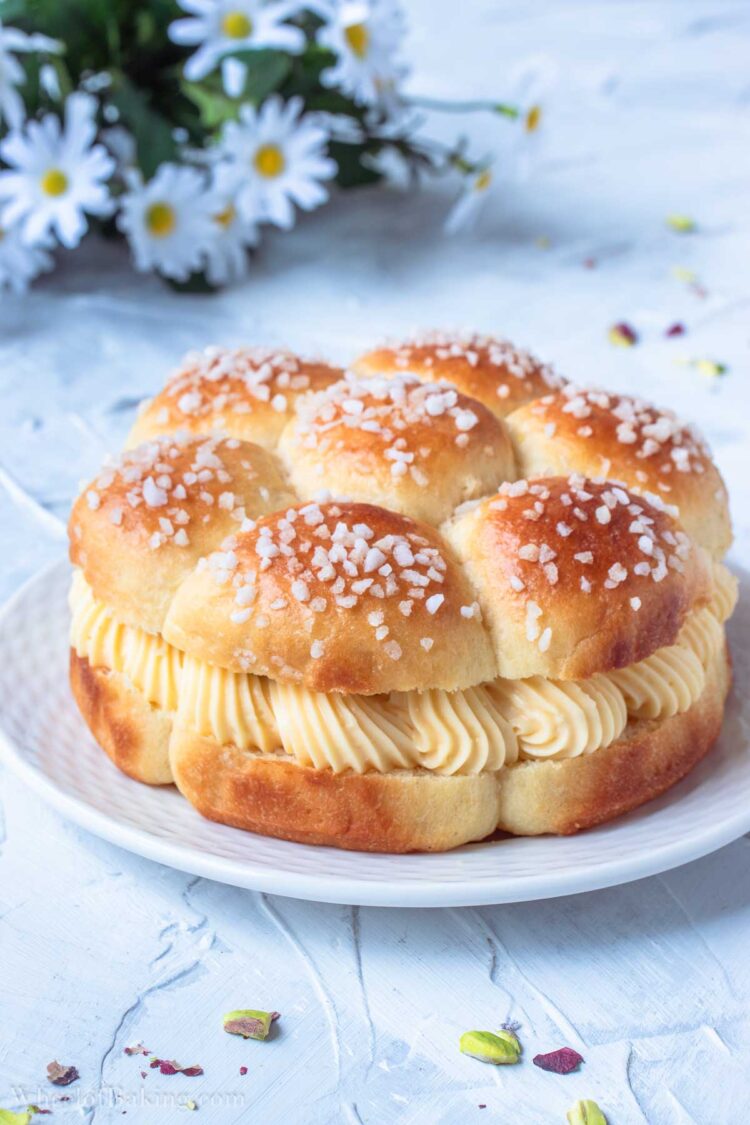
This Tropezienne recipe inspired by the famous Tarte Tropézienne of Alexandre Micka consists of a brioche brushed with syrup, a wonderfully rich mousseline cream flavored with orange blossom and a crunchy pearl sugar topping. For even more crunch, sprinkle chopped pistachios on the cream.
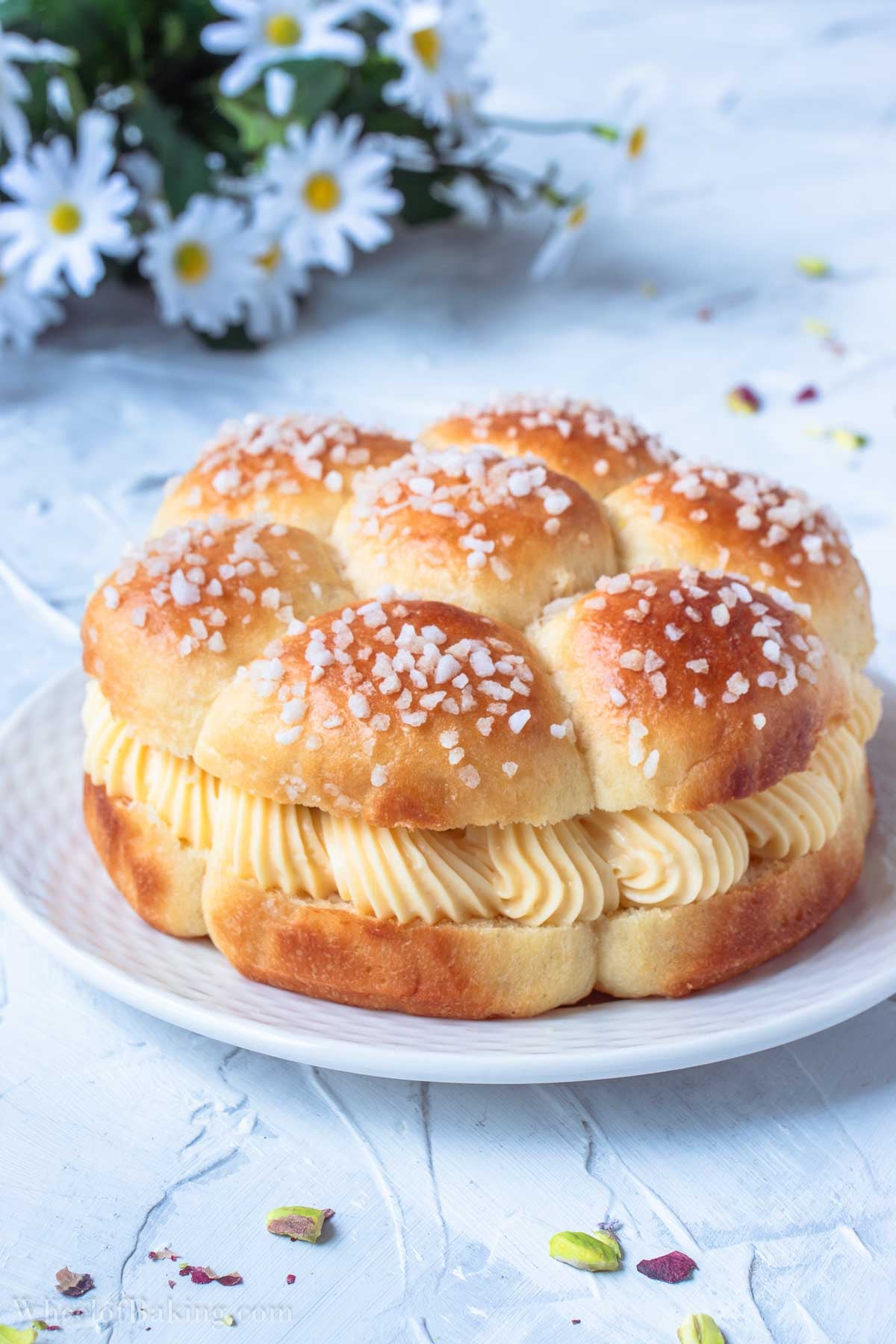
Overview
There are two main components to prepare: the brioche dough and the mousseline cream. You could also make a syrup if you plan on storing the Tropezienne for a while, to ensure the brioche doesn’t dry out. For the topping, you’ll just have to brush the dough with egg wash and sprinkle some pearl sugar.
In case you missed it, I previously shared a detailed tutorial on brioche when making brioche Suisse with lots of troubleshooting tips. I also shared how to get a smooth mousseline cream without lumps when making the Fraisier cake. As a reminder, mousseline cream is a combination of pastry cream and softened butter that have been whipped together until silky smooth and airy.
You can read more about the different types of pastry cream and even grab your free printable pastry cream guide.
Here’s a brief overview of the process for making the Tropezienne:
- Make the brioche dough and let it rise.
- Prepare the syrup, if using.
- Shape the brioche and let it rise once more.
- Prepare the pastry cream and chill briefly.
- Add the softened butter and whip until smooth. Chill in a piping bag until needed.
- Brush the brioche with egg wash and top with pearl sugar then bake.
- Once cooled down completely, slice horizontally in two. Brush with syrup if desired.
- Pipe mousseline cream on the bottom layer, sprinkle chopped pistachios then place back the top part.
And that’s it, your Tropezienne is ready. If this seems like too much to do in one day, you can divide the work over several days. Here’s one example:
- Day 1: Prepare the syrup. Chill until needed.
- Day 2: Make the brioche dough and bake. Once cooled down, store in an airtight container at room temperature.
- Day 3: Make the mousseline cream and assemble the dessert.

Step-by-Step Instructions
Making the dough
- Place the dry ingredients in the mixing bowl: flour, sugar and salt. Give it a quick stir to combine.


- Add the egg and the yeast that was previously dissolved in milk.
- Mix until all the ingredients are combined and the dough can be stretched a little.


- You can now gradually add the butter. Scrape the bowl as needed.


- Once all the butter has been incorporated, increase the speed and keep kneading until the dough is elastic.


- Transfer the dough to a measuring cup. Cover and let it rise until about doubled in volume.


- Gently punch down the dough and divide into 7 equal pieces.
- Shape each piece into a ball and place in a baking pan greased and lined with parchment paper.
- Let it rise once more until puffy.


- Brush with egg wash and sprinkle with pearl sugar before baking in a preheated oven until golden brown.
- Cool down briefly in the pan then unmold and cool down completely on a wire rack.


Making the mousseline cream
The process is relatively simple. We’ll first start by making pastry cream. Once cooked, we’ll have to cool it down a little before adding the diced butter which should be at about the same temperature. This will ensure we get the best texture possible, no lumps of butter or puddles of melted butter!
- Transfer the cold pastry cream to a mixing bowl and mix to loosen.
- Add the butter gradually, mixing well between each addition. Keep mixing until completely smooth and airy.
- Chill briefly in a piping bag before filling the brioche.


Assembling the Tropezienne
- Slice the brioche in half. You can brush a little bit of syrup at this point if you’d like.
- Pipe mousseline cream on the bottom half of the brioche and sprinkle chopped pistachios. Place back the top of the brioche and enjoy!


You Might Also Like
LOVE THIS RECIPE? I’d be so grateful if you could leave a ⭐⭐⭐⭐⭐ rating in the recipe card below!
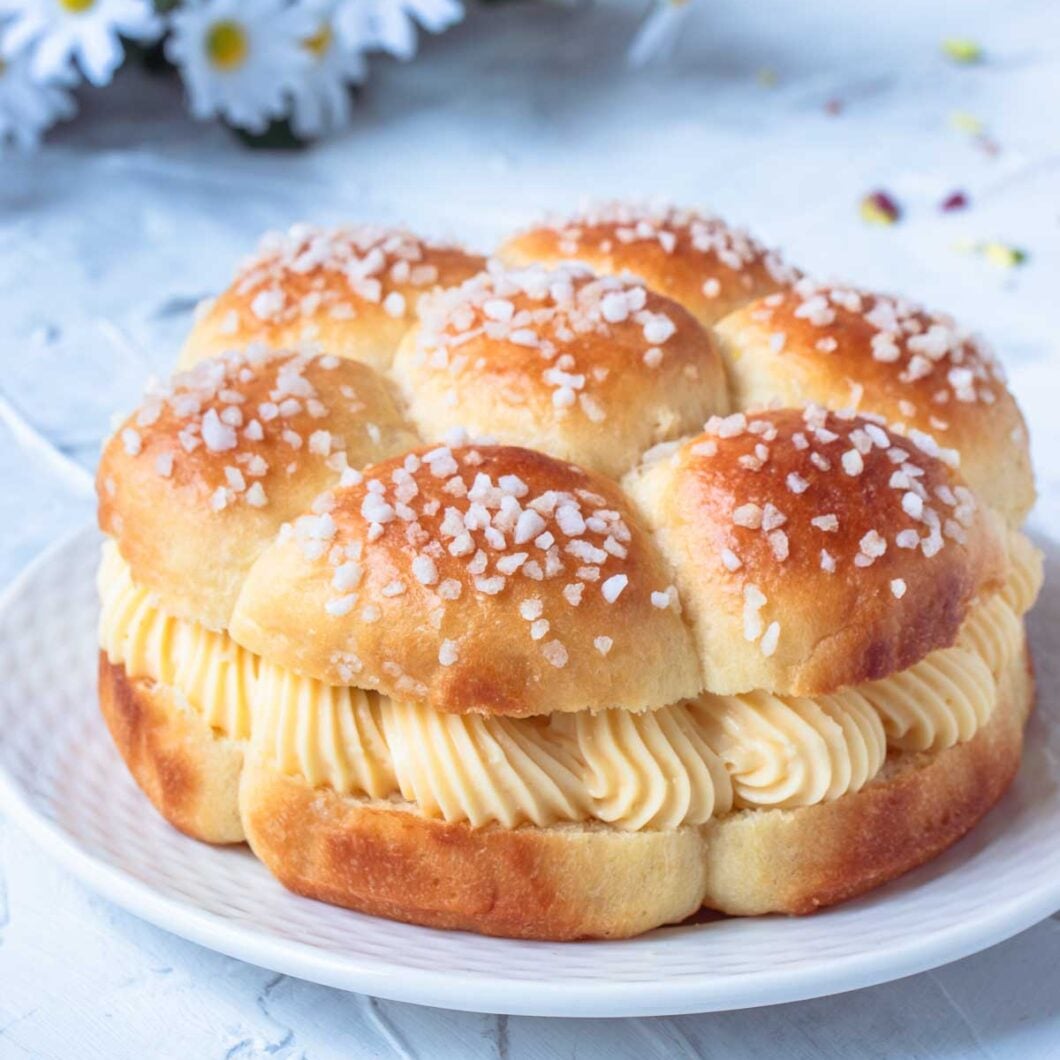
Tropezienne (Small Batch Recipe)
This Tropezienne recipe inspired by the famous Tarte Tropezienne of Alexandre Micka consists of a brioche brushed with syrup, a wonderfully rich mousseline cream flavored with orange blossom and a crunchy pearl sugar topping.
)
6
inch cake1
hour25
minutes6
hoursIngredients
- For the brioche
4 g fresh (cake) yeast (0.14 oz.), or 1/2 teaspoon instant yeast
5 g whole milk, cold (0.18 oz., 1 teaspoon)
90 g all-purpose flour (3.2 oz., 2/3 cup)
12 g white granulated sugar (0.42 oz., 1 Tablespoon)
2 g salt (0.07 oz., 1/3 teaspoon)
50 g egg, without the shell (1.8 oz., 1 large egg)
50 g unsalted butter, diced, softened at room temperature but still cold (1.8 oz., 3 and 1/2 Tablespoons)
10 g Swedish pearl sugar (0.35 oz., 3/4 Tablespoon), or to taste
- For the syrup
50 g water (1.8 oz., 3 and 1/3 Tablespoons)
50 g white granulated sugar (1.8 oz.,1/4 cup)
- For the mousseline cream
180 g whole milk (6.3 oz., 3/4 cup)
2 large egg yolks (about 35 g, 1.2 oz.), at room temperature
40 g white granulated sugar (1.4 oz., 3 and 1/2 Tablespoons)
18 g cornstarch (0.63 oz., about 2 and 1/3 Tablespoons)
40 g unsalted butter, diced and softened at room temperature (1.4 oz., 3 Tablespoons)
1/2 teaspoon vanilla extract
1/2 Tablespoon orange blossom water (7 g/0.25 oz.), or to taste (optional)
40 g unsalted butter, diced and softened at room temperature to about 16-18°C (61-64°F) (1.4 oz., 3 Tablespoons)
- To serve
10 g shelled pistachios, chopped (0.35 oz.) (optional)
Directions
- Making the brioche
- Crumble the fresh yeast into a small cup. Pour the milk over it (don’t stir yet). If using instant yeast, sprinkle it over the milk. Set aside for 5-10 minutes while you prepare the remaining ingredients.
- Place the flour, sugar and salt in the bowl (2.8 L/3 qt capacity) of a stand mixer fitted with the paddle attachment. Briefly stir to combine with a wooden spoon.
- Mix the yeast mixture with a fork to dissolve then pour over the flour mixture along with the egg.
- Mix on low speed for about 3 minutes or until a dense, elastic dough forms. Stop the mixer to scrape the bowl if needed. Tip: Try stretching a small piece of dough (with lightly oiled hands if needed) to determine if it is elastic.
- Gradually add the diced butter (in about 6 additions) while mixing on low speed. Wait for the butter to be fully incorporated before adding more. Turn off the mixer occasionally to scrape the bowl. This step will take about 5 minutes.
- Once all the butter has been incorporated, increase the speed to medium-low (speed 3-4 on a KitchenAid or keep low speed if preferred and mix for longer). Keep mixing until the dough is elastic and passes the windowpane test, about 10-15 minutes, scraping the bowl as needed. Windowpane test: The dough is ready when you can slowly stretch a small piece of dough (with lightly oiled hands) into a thin layer that lets light through without tears. If it tears immediately, keep kneading the dough for a few more minutes before trying again.
- Shape the dough into a ball by tucking the sides under and smoothening the surface (with lightly oiled hands). Place in a measuring cup (2 cup capacity) or return to the mixing bowl (you’ll get slightly over half a cup of dough). Cover with cling film. Tip: The measuring cup makes it much easier to determine when the dough has doubled in volume, which is otherwise tricky in a small batch recipe.
- First rise: Let rise in a warm place (free from drafts) until almost doubled in volume, about 3 hours (you can prepare the syrup while you wait). Tip: The rise time can vary a lot depending on the temperature of your dough/kitchen. If your kitchen is very cold, place the dough near a heater, or in the middle of a switched off oven with the light on (and a cup of boiling water on the bottom rack if desired). If your kitchen is too warm, try finding a cooler spot in the house.
- Grease then line the bottom and sides of a 15 cm (6 inch) springform pan with parchment paper. Tip: If you don’t have a pan, simply line a baking sheet with parchment paper.
- Shaping the dough: Gently punch down the dough and divide into 7 equal pieces, about 28 g (1 oz.) each. Shape each piece into a smooth ball and place in prepared pan in the shape of a flower (one in the middle, 6 around it). Cover loosely and let rise until puffy, about 90 minutes to 2 hours, while you prepare the filling. Tip: If the dough is too soft to handle, chill (well covered in cling film) until firm enough. Quick version: Forego the flower shape and simply press all of the dough into a 6 inch circle (either in the pan or on the baking sheet).
- Before the end of the rise time, preheat the oven to 180°C (356°F, conventional setting). Uncover the brioche and brush the surface with egg wash (leftover egg white briefly mixed with a fork to loosen). Sprinkle with pearl sugar. Bake in the middle of the oven until golden, 13-15 minutes. A thermometer inserted into the center of the brioche (without touching the bottom) should register about 88°C/190°F. Tip: Be careful not to overbake so it doesn’t come out dry.
- Cool down in the pan for about 10 minutes. Then remove from the pan and cool down completely on a wire rack before slicing (or storing in an airtight container).
- Making the syrup
- Pour the water into a small saucepan then add the sugar. Bring to a boil over medium heat, stirring occasionally until the sugar has fully dissolved. Let it boil for about a minute then remove from the heat and cool down before using.
- Making the mousseline cream
- Making the pastry cream: Heat the milk in a small saucepan until steaming.
- Meanwhile, whisk the egg yolks and sugar in a heatproof bowl. Then mix in the cornstarch until smooth. Tip: Whisk as soon as you add the sugar to the yolks so you don’t end up with lumps.
- Gradually pour the hot milk into the egg mixture in a thin stream, whisking constantly (to avoid cooking the eggs).
- Pour the mixture back into the saucepan and cook over medium heat, whisking constantly. When the pastry cream starts to thicken (about 4 minutes), lower the heat if needed and check for bubbles forming (stop whisking occasionally to check). Once you see bubbles, let it boil for about 30 seconds (to get rid of any starchy taste) and remove from the heat.
- Add the first portion of butter (40 g/3 Tablespoons) and whisk until fully combined. Then whisk in the vanilla extract and orange blossom water.
- Pour into a wide container and spread in a thin layer (to cool down quickly). Place a piece of parchment paper or cling film straight onto the surface of the cream to prevent a skin from forming. Cool down briefly at room temperature (10-15 minutes) then chill for as long as needed until the temperature of the cream is about 16-18°C (61-64°F), about 30 minutes. Tip: The thinner the layer of pastry cream, the faster it will cool down.
- Making the mousseline cream: Transfer the pastry cream to a mixing bowl and mix on low speed to loosen, 2-3 minutes.
- Gradually add the softened butter (40 g, 3 Tablespoons) in 5 additions and keep whipping until the cream is silky smooth, glossy and holds its shape, about 10 minutes. Scrape the sides of the bowl with a spatula as needed.
- Transfer to a piping bag fitted with desired tip (I used Wilton 4B). Chill until cold and easy to pipe, if needed (about 30 minutes).
- Assembling the Tropezienne
- Using a cake leveler or a knife, slice the brioche (cooled down) horizontally in half. Place the bottom layer on a serving plate and brush with syrup (as much as desired).
- Pipe mousseline cream on the brioche and sprinkle with chopped pistachios. Lightly brush the top part of the brioche with syrup if desired and place over the cream. Chill for about an hour for easy slicing or serve immediately if desired. If chilled, let it sit at room temperature for about 10 minutes before serving (for the brioche to soften). Enjoy!
Notes
- Make-ahead tips: The assembled Tropezienne is best served on the day that it’s made but will keep in the fridge, well covered, for about 2 days. The syrup can be prepared days in advance and stored in the fridge. The brioche can be baked the day before and stored in an airtight container once cooled down.
- Dough: I’m using all-purpose flour with a protein content of 11% (written in the nutritional table of the packaging). The dough is quite sticky but should be easy to handle with lightly oiled hands once kneaded enough (step 6). Only add more flour if it’s too soft to handle even after lengthy kneading and do so very gradually to avoid adding more than needed (which would result in a dry brioche). If the dough feels too dry on the other hand, add a little bit more milk to soften.
- Mixing the dough: This is a small batch recipe and the amount of dough is quite small. Scrape the bowl occasionally for even mixing. You might also want to adjust the beater to bowl clearance if needed to make sure the paddle actually reaches the dough without hitting the bottom (there are online tutorials for different models). Note that I’m using a 2.8L/3 quart mixing bowl. If the quantity is too small for your mixer, you can make a larger portion of dough and use leftover dough for other purposes (eg. small brioche buns, braided brioche).
- The ideal temperature of the dough when you’re done mixing it should be between 22°C (72°F) to 25°C (77°F). If your kitchen is warm, it’s best to start off with cold ingredients (eggs, flour etc.) so the dough doesn’t warm up too much during mixing.
- Egg: You should ideally weigh the egg to avoid adding too much liquid (overly sticky dough) or too little liquid (dry brioche).
- Butter: It’s best to use European style butter with a fat content of 82% (American butter is 80% fat). Make sure it’s cut into small pieces so it’s easy to incorporate into the brioche and the mousseline cream.
- Syrup: Optional, but recommended if you don’t plan on serving the brioche the day you make it. Feel free to add flavorings (such as orange blossom water) once the syrup has cooled down a little. It’s best to brush the brioche with syrup just before assembling the dessert as it can become very moist and hard to handle.
- Mousseline cream: If you’d rather not crack two eggs and have leftover egg whites, you can use 35 g of one whole egg instead of two egg yolks. The cream won’t be as rich but will still be very nice. To do so, use one egg yolk (about 17 g/0.6 oz.) and 18 g (0.63 oz.) egg white. You can save the remaining egg white for the egg wash. Alternatively, simply crack the egg into a small cup and whisk it before weighing out 35 g.
- The pastry cream and softened butter should ideally be at the same temperature. A large temperature difference will make it harder to combine the two components and might result in a lumpy cream. Use an immersion blender if needed to get rid of lumps then continue mixing with the hand mixer until airy.
- No piping: If you’d rather not pipe the cream, you can simply spoon it onto the brioche once it’s ready. Leave a small border around the edge to allow for slight spread when you place the top back on.
- Cup measurements: Please note that these measurements are approximate. For best results, I’d recommend weighing the ingredients, especially the cornstarch.